
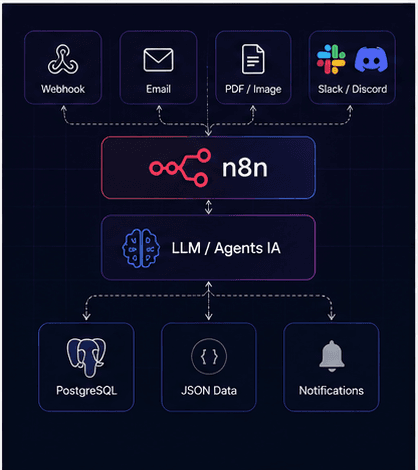
Beyond web development, intelligent automation has become a major productivity multiplier. With n8n, LLMs, and AI agents, I can build workflows that understand unstructured data and then execute business actions.
The important distinction is between text generation and reliable automation. A production workflow should combine probabilistic AI + deterministic rules + persistence + supervision.
A simple architecture
Trigger
   │
   ▼
n8n
   │
   ├──► LLM / Agent
   │       │
   │       └──► Structured JSON
   │
   ├──► Business validation
   │
   ├──► PostgreSQL
   │
   └──► Slack / Email / CRM
n8n orchestrates. The LLM interprets. PostgreSQL stores state. Deterministic rules decide what is actually allowed.
1. Classifying emails or tickets
A workflow can receive:
{
  "subject": "I cannot log in",
  "body": "My account has rejected my password since this morning."
}
The model can return:
{
  "category": "authentication",
  "priority": "high",
  "summary": "User cannot log in",
  "needs_human": false
}
I always request a strict format instead of trying to parse a freely generated paragraph.
2. Validating the model output
An LLM result should never be treated as absolute truth.
Inside an n8n Code node, I can verify it:
const data = JSON.parse($json.output);

const allowedCategories = [
  "authentication",
  "billing",
  "technical",
  "other"
];

if (!allowedCategories.includes(data.category)) {
  throw new Error("Invalid category");
}

return { json: data };
Deterministic logic protects the workflow from unexpected outputs.
3. Extracting data from documents
Another pipeline can look like:
PDF / Image
   │
   ▼
Text / vision extraction
   │
   ▼
LLM
   │
   ▼
Structured JSON
   │
   ▼
Validation
   │
   ▼
PostgreSQL
For example:
{
  "invoiceNumber": "INV-2026-042",
  "supplier": "Example Corp",
  "total": 125000,
  "currency": "XAF"
}
The system can store those fields without requiring a human to manually retype them.
4. Keeping a human in the loop
Some decisions should not be fully automated.
I can define a rule:
confidence < 0.85
        │
        ▼
Human approval
The workflow then sends a Slack or email notification containing the extracted information and waits for approval.
5. Using PostgreSQL as business memory
n8n should not become the only source of state.
I can store:
- document identifier;
- model result;
- validation status;
- execution identifier;
- timestamp;
- possible error.
This makes auditing and replaying workflows much easier.
6. AI agents and tools
Agents become useful when a task requires multiple actions:
User request
     │
     ▼
   Agent
  /  |   Search DB  API
     |
   n8n tools
I still limit the tools exposed to the agent. Each tool should have a clear responsibility and minimum permissions.
Reducing hallucinations
I prefer to:
- give the model only the required context;
- enforce an output schema;
- validate fields;
- retrieve critical facts from trusted sources;
- require human confirmation for sensitive actions.
AI should interpret or propose. Deterministic systems should control.
Reliability and idempotency
A webhook can be received twice. A workflow can also be retried.
I therefore create event identifiers and prevent duplicate writes:
INSERT INTO automation_events (event_id, status)
VALUES ($1, 'processed')
ON CONFLICT (event_id) DO NOTHING;
This becomes essential as soon as automation touches business data.
My approach
I do not try to replace the entire backend with AI.
Instead, I build pipelines where:
n8n orchestrates → the LLM interprets → code validates → PostgreSQL persists → humans intervene when necessary.
That combination is what makes intelligent automation genuinely useful in production.